The balance sheet, officially called a “Statement of Financial Position” in the case of nonprofits, is arguably one of the most important reporting documents that your nonprofit will produce, both for internal decision-making and external evaluation. It’s full of jargon, but when we take a closer look, it’s more straightforward than it seems at first glance. In this guide, we spell out everything you need to know about your organization’s balance sheet in simple terms.
What Is a Balance Sheet?
A balance sheet is a snapshot in time that shows what your nonprofit owns and what your nonprofit owes. Let’s break that down a little further.
“A Snapshot in Time”
The balance sheet does not show progress over time, it only shows your organization’s financial position at a certain moment in time. Usually, a balance sheet is produced at the end of a reporting period. (For example, if your fiscal year ends on December 31, 2026, your balance sheet might be dated December 31, 2026.) While other financial reports, like the Statement of Activity (SoA) (the nonprofit equivalent of a Profit and Loss statement), show what happens during a financial reporting period, the balance sheet does not.
“What Your Nonprofit Owns”
Your assets are anything that your nonprofit owns. Assets can be liquid (or “current”) – cash or something that can be easily converted to cash within the next twelve months – or fixed (or “noncurrent”) – not easily convertible into cash in the next twelve months. More on that later.
What Your Nonprofit Owes
Your liabilities are debts or other obligations that your nonprofit owes. Like assets, liabilities can be current – payable within the next twelve months, or noncurrent – you’ll pay them off more than twelve months from now.
Total Net Assets
The bottom line of a balance sheet is your nonprofit’s total net assets. This is the difference between your total assets and your total liabilities. In other words, if your nonprofit converted all your assets into cash and paid off all of your liabilities, the amount of cash you would have left over would be your total net assets. Hopefully, this is a positive number. In the business world, total net assets is “stakeholder equity”. For a business, this would represent that value that the business created for its owner. For nonprofits, we could think of the public as our owners, and consider net assets as what we could give to another entity or cause if we decided to shut down.
Anyhow, the balance sheet gets its name because it always balances based on these formulas:
Net assets = Total assets – total liabilities OR
Total Assets = Total liabilities + Net assets
If it’s not balanced, there’s been an error in the preparation of the balance sheet.
For nonprofits there is also another important concept called Net Assets with restrictions, and we will discuss that below.
Who Reads Your Balance Sheet?
Hopefully, you! The balance sheet is an important piece of the puzzle when it comes to understanding your organization’s full financial picture. Your board, especially your finance committee, should be looking at AND interpreting your balance sheet, along with your other financial reports, at least monthly.
Beyond your board, the balance sheet will also be scrutinized by diligent grant funders to assess the financial health of your organization. The balance sheet can be analyzed to reveal insights about things like your organization’s liquidity (how easily your assets can be converted into cash) and working capital (funds available to meet day-to-day needs.) Your other financial documents, such as your SoA, will give the balance sheet context.
Anatomy of a Balance Sheet
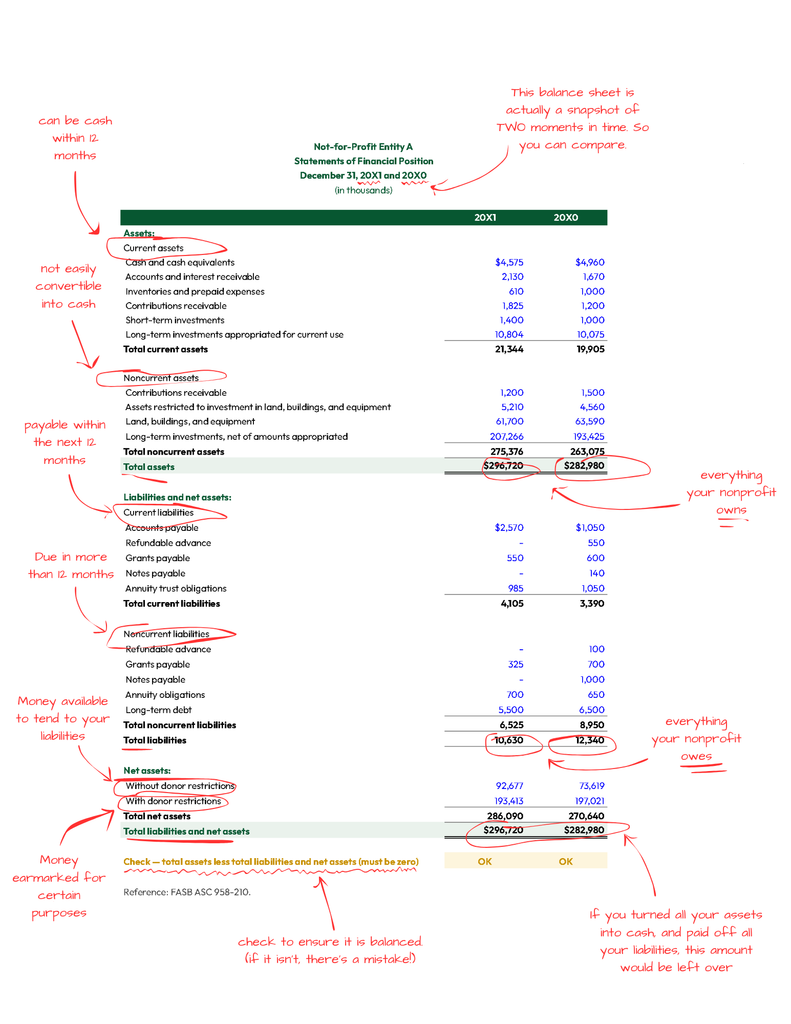
With all that in mind, let’s take a look at a sample nonprofit balance sheet together. Take a look below and keep reading for a detailed explanation.
Assets
A balance sheet first lists assets organized in order of descending liquidity. First are current assets. These include:
- Cash
- Money Market Funds
- Short-term Certificates of Deposits
- Pledges receivable (donations that donors have formally pledged, but not yet paid)
- Grants receivable (grants that funders have awarded, but not yet paid)
- Receivables (Money that customers or clients owe you for products and services you have already delivered. For nonprofits these might be pledge receivables or what you are owned for services)
- Prepaid expenses (like an insurance premium that you have already paid and covers the next year)
- Inventory (if you sell a product)
Then, it lists fixed or noncurrent assets:
- Publicly traded stock
- Land
- Buildings
- Equipment
- Intangible Assets like Intellectual Property
Liabilities
Liabilities come next, also organized by current and noncurrent. Current liabilities include:
- Accounts payable (payments you owe on invoices you have received)
- Accrued expenses (expenses that have occurred, but you have not paid for yet)
- Grants payable (if you are a grantmaking organization, grants you’ve promised but not payed)
- Deferred revenue (any payments your organization has received for goods or services not yet delivered)
- Restricted grant funds received but with unmet conditions (for example, matching funds, that if you don’t make the match, you will have to return. These are labeled various ways in the balance sheet, they may be called “Deferred Revenue,” “Advanced Payments” or “Conditional Grants.” Regardless of what they are called they are always liabilities because you owe the money back unless you meet the conditions.)
Noncurrent Liabilities Include:
- Bond liabilities
- Mortgages
- “Notes Payable” (a fancy way to say, “loans”)
A Special Nonprofit Twist: Restricted Assets
Of course, a nonprofit balance sheet would not be complete without a nonprofit-flavored wrinkle. The balance sheet must also account for restricted funds. These show up near the bottom of the balance sheet under “Net Assets”. In that section, you will specify “Net Assets Without Donor Restrictions” and “Net Assets With Donor Restrictions”. This differentiation helps you and your funders understand how much money you actually have access to in order to tend to your liabilities.
Putting Together a Balance Sheet Is Just the Start
A well-organized accounting software like Quickbooks will produce a balance sheet with just a few clicks. Like all your finances, your balance sheet will only be as accurate as your books. And, the bigger, more important step is interpreting your balance sheet.
We suggest you review your Statement of Financial Position/Balance Sheet every month at least, but this report takes on heightened importance at particular times. These include periods where your cash flow is stressed, you are thinking about making big capital investments, need a loan or what to show a major funder that you have the depth to deliver.
We’re here to help. If you’d like to engage a professional to assemble a balance sheet, interpret a balance sheet, or clean up your books, send us a message. We’re experts in breaking nonprofit finance down into simple terms, and our mission is supporting organizations in building sustainable financial futures.
Resources and More
Your accounting software, (like Quickbooks) should make your balance sheet for you. However, if you want to practice with our sample balance sheet, you can download it here:
This blog post was written with the assistance of the following materials:
- JP Morgan: Strengthen Financial Health via Working Capital Management
- Netsuite: Nonprofit Balance Sheet Explained
- Paylocity: Deferred Revenue
- US Chamber: A Quick Guide to Accounts Receivable
- YPTC: What Is a Nonprofit Balance Sheet? Breaking Down This Report
- Understanding Nonprofit Law & Finance: 48 Key Principles for Philanthropic Leaders by Erik Estrada
This article is for general informational purposes only and does not constitute professional accounting, tax, or legal advice. Tax laws, regulations, and accounting standards change frequently, and the application of rules can vary based on your organization’s specific facts and circumstances. Before acting on anything you read here, consult a qualified professional who can advise you based on your situation.