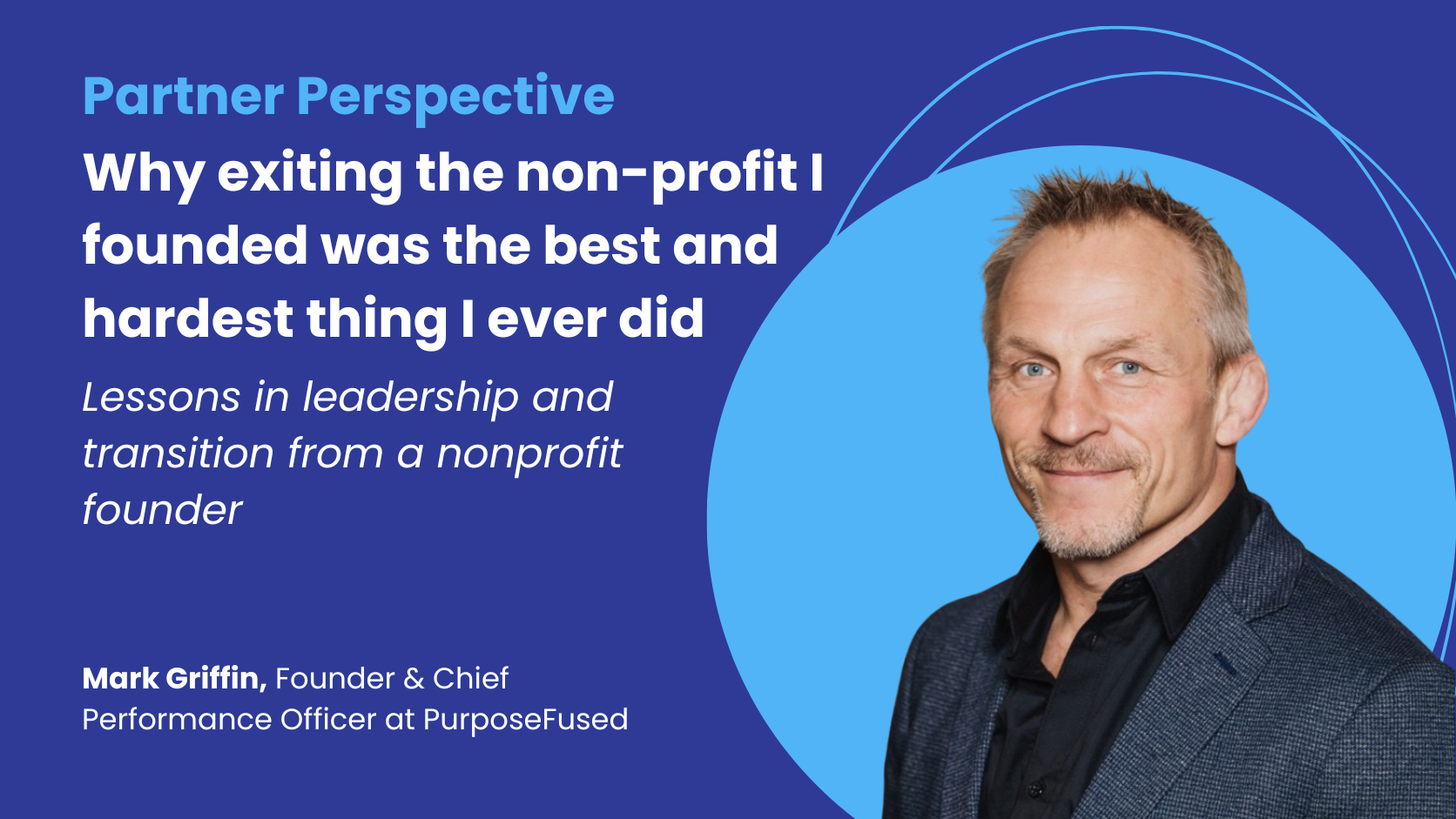
By Mark Griffin, Founder & Chief Performance Officer at PurposeFused
Perhaps one of the hardest professional things I have ever had to do was to thoughtfully exit the non-profit I had founded: Play Rugby USA (PRUSA), after 15 years of leading it.
Being back in NYC this week I reconnected with many donors and former board members, some of whom I’ve known for 20 years! So many hugs, kisses (yes I’ve been known to kiss a cheek or two), smiles, and laughs. Shared experiences and memories from the good old days. One of the highlights was Jon Shifty (photographed above), speaking for the third time in ten years on behalf of PRUSA about how the coaches, program, game and community changed his life.
That impact is what kept driving me forward, during the tough times, too.
I remember clearly the first board meeting of 2016, when I announced to the board, for the minutes, that I would be exiting Play Rugby USA by December 31, 2018. I gave nearly three years’ notice!
That same year was the peak of both our program impact and organizational pressure points! We nearly missed payroll three times and I was short on my mortgage payment the day before it was due. I happened to be going through a separation at home too. I remember breaking down in front of my leadership team at a retreat–ironically after receiving some really positive feedback. My mind was so full emotionally, I couldn’t fit anything else in–not even the positives! I burst into tears! Oopsie!
Somehow, we always found a way. We were pioneering a field, blazing a trail, making a huge impact. I was also good at juggling! Very good! Additionally, great at getting people to follow and support. It was a dangerous combination. Also, as we all know, not a model for scale! I couldn’t get out of my own way, and I knew it. At least, I knew it.
Leadership team transitions happen periodically across organizations. For some of the reasons already referenced and many more, founder transitions can be the most turbulent. Since, I have coached some founders through growth and preparation for exit, for them and for their business. It tends to come as a package deal with founders!
Below are five pointers for founders and five pointers for their businesses, so both can transition and thrive instead of fighting to stay alive.
Dealing with these up front with thought, care, and intentionality is critical not just for the founder but also for the business. Support, whether in the form of professional services such as counseling or coaches (I know a guy 😉), establishing mentors (like a couple of my board members were to me), leaning on friends, network and family, is huge.
Top 10 Pointers for a Successful Founder Exit
(I’ve learned these through both hits and misses)
For the founder:
- Separate from emotional attachment: Often your organization is your passion project, which has taken considerable time, energy, resilience, and perseverance to build. Letting go is very hard as it feels a bit like your professional baby!
- Refresh your identity: Play Rugby USA was a professional extension of my personal passions for rugby, kids, education, and entrepreneurship. It became my vehicle for engaging, speaking, leading, coaching, inspiring, growing, etc. I was known as “The Play Rugby Guy” for years but beneath all that was a fundamental drive for human performance and development. That bridged directly into what I do now.
- Prepare for a loss of control: It was hard to hand over control of something I had imagined and built from scratch. I knew it was the right thing to do but it has meant that after fifteen years, I hugely value control over my time and energy, and having autonomy to do what I feel is the right thing. Having a number of the business elements below in place, made stepping away easier.
- Rebuild community and connection: For twelve years Play Rugby USA was my professional community, although, in many respects it felt stronger than that–like an extended family. I had strong connections with my colleagues, board members, and some key donors. I’ve been rebuilding these since, in a new city and state. My community now is awesome too–just very different from what it was before.
- Rediscover purpose to navigate uncertainty: I did a lot of self-reflection that dug beneath rugby as a game and the various roles I had played in the game on and off the field, to what was driving me inside. I reflected on the principles that drove me across all areas of my life, I thought about how I wanted to continue making an impact and what different ways I could do that. This brought me to my purpose: “to create opportunities that inspire people to go forward as the ultimate version of themselves” and more importantly a One Page Purpose, which provided me absolute clarity and confidence in my next chapter.
My mission in life now is for everyone to have a One Page Purpose! It’s a best-self life plan on a page, within which you can be the best, most impactful leader for others. It’s an absolute game-changer!
For the business:
- Bolster your leadership and identify the replacement: For us, this was the current leadership team, surviving board members, and recognizing we needed to bring in a new executive director to replace me. The new executive director, Wil Snape-Rodgers, and I had two months of overlap. Wil continues to do a terrific job having led 173% growth over the last 18 months.
- Systemize methods and models: Ensure processes are documented, stakeholders are captured and communicated with, governance models are understood, and systems are up to date.
- Nurture financial health: This was brutal for us. I had to cut the organization and programs in half in order to hand over something manageable. It’s the hardest thing I’ve ever done but it was a non-negotiable if I wanted the organization to survive beyond me.
- Champion the culture: A well-established company culture, with complete alignment and commitment from leadership to its vision, mission and values is vital. We had this between our key staff and board, although I’d say we were better at it with programming than in the office.
- Engage and embrace stakeholders: This was critical in the non-profit space. Having a broad base of diverse stakeholders is the lifeblood of non profits. It ensures there’s sufficient revenue and resources to support program beneficiaries who often tend not to be in a position to pay, or at least not at a profit.
Although there are of course many other factors to consider around the nature of the exit, these ten elements are absolutely fundamental to success. They enable programs like Play Rugby USA to continue to make impact years beyond the founder leaving. A big shout out to Wil Snape-Rogers and board chair Vito Sperduto for driving continued, meaningful and thoughtful growth.
Learn more about Mark and his coaching practice aimed at supporting senior leaders through transitions here: https://www.purposefused.com/.
Partner Spotlights bring you insights from consultants with expertise in all aspects of the nonprofit sector: leadership, fundraising, marketing, evaluation, and more.